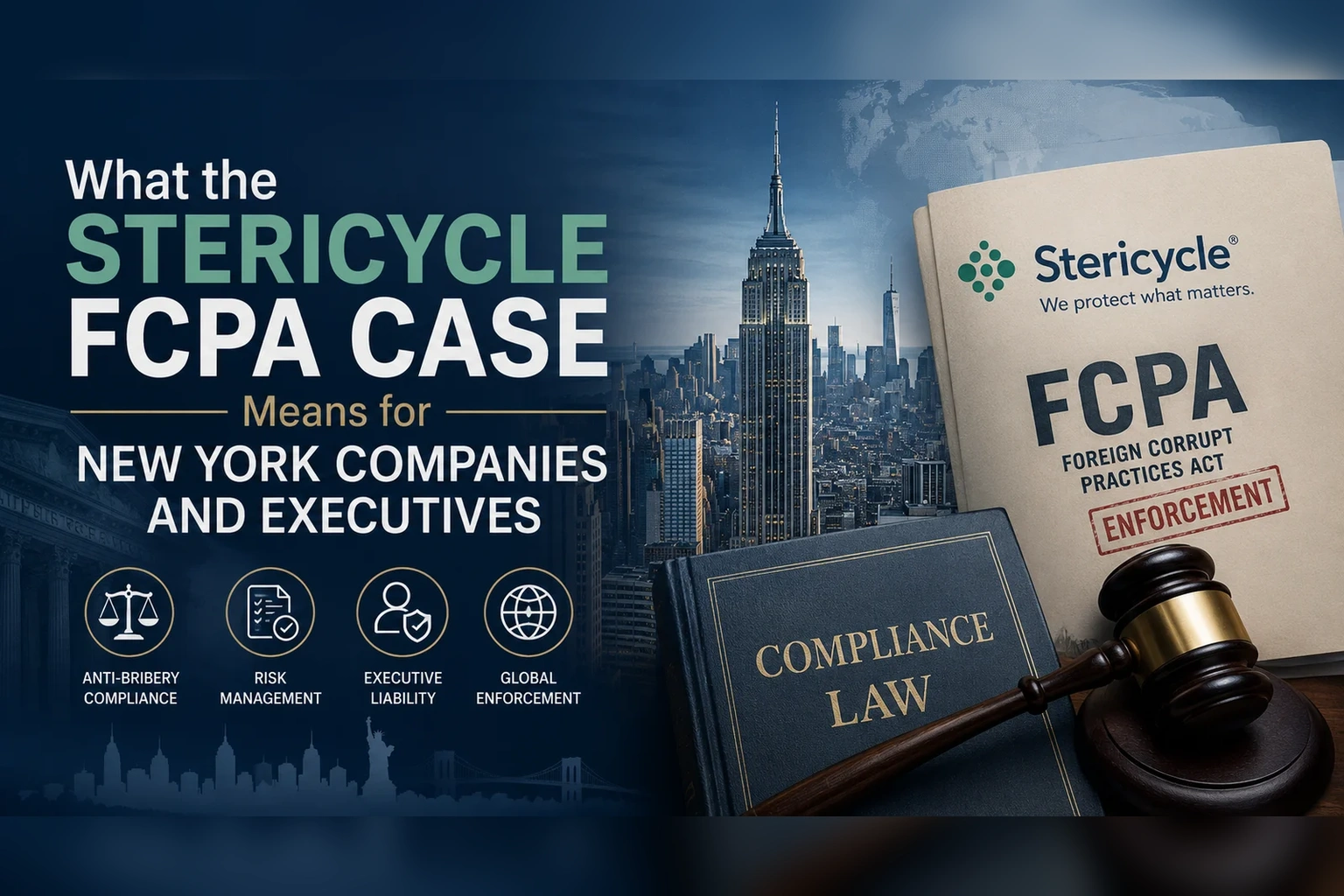
On May 21, 2026, Abraham Cigarroa Cervantes — the former finance director of Stericycle Inc.’s Latin America division — pleaded guilty in the Southern District of Florida to conspiracy to violate the Foreign Corrupt Practices Act’s anti-bribery provisions. In his factual proffer, Cigarroa admitted that between 2011 and 2016 he and other Stericycle employees conspired to pay approximately $3.5 million in bribes to Mexican government officials, with related payments in Brazil and Argentina, to help the Illinois-based waste management company win and keep government contracts. His supervisor, Mauricio Gomez Baez, pleaded guilty in 2024 and was sentenced to seven months in prison; Stericycle itself resolved parallel DOJ and SEC allegations in 2022 for roughly $84 million. Cigarroa’s sentencing is scheduled for July 10, 2026. While the underlying conduct occurred in Florida and Latin America, the case is a useful illustration for any New York-headquartered company or executive, since Manhattan is home to more multinational issuers and financial institutions subject to the FCPA than almost anywhere else in the country. Companies and individuals facing similar exposure typically move quickly to engage an experienced NY white collar lawyer once an internal red flag or government inquiry surfaces.
How the FCPA Reaches New York Companies and Executives
The FCPA applies to three categories of actors: public companies that file reports with the SEC (“issuers”), U.S. persons and companies (“domestic concerns”), and, in some cases, foreign persons acting within U.S. territory. Because so many issuers are headquartered or listed in New York, and because the Southern and Eastern Districts of New York are among the most active FCPA enforcement venues in the country, Manhattan-based executives, compliance officers, and finance personnel are squarely within the statute’s reach even when the underlying bribes are paid entirely overseas.
| Offense | Statute | Key Element | Maximum Penalty |
| FCPA Anti-Bribery (Issuers) | 15 U.S.C. § 78dd-1 | Bribing foreign officials to obtain/retain business, by a public company | Up to 5 years (individuals); corporate fines up to $2 million per violation |
| FCPA Anti-Bribery (Domestic Concerns) | 15 U.S.C. § 78dd-2 | Same conduct by a U.S. person, company, or resident | Up to 5 years; corporate fines up to $2 million per violation |
| FCPA Books and Records | 15 U.S.C. § 78m(b)(2) | Falsifying corporate books to conceal improper payments | Up to 20 years; corporate fines up to $25 million |
| Conspiracy | 18 U.S.C. § 371 | Agreement between two or more people to violate federal law | Up to 5 years |
| Money Laundering | 18 U.S.C. § 1956 | Moving or concealing proceeds of the underlying bribery scheme | Up to 20 years |
As in the Cigarroa case, FCPA prosecutions frequently pair anti-bribery charges with books-and-records and false-certification allegations — prosecutors highlighted that Cigarroa allegedly signed falsified Sarbanes-Oxley certifications attesting the company’s books were accurate, turning an overseas bribery scheme into a direct securities-law compliance failure.
New York’s Own Bribery and Fraud Statutes
New York does not have a direct state-law equivalent to the FCPA, but conduct that resembles a foreign bribery scheme — falsified books, disguised payments, and bribery of officials — frequently overlaps with existing New York Penal Law and General Business Law provisions. State prosecutors, including the New York Attorney General’s office, can and do pursue parallel or follow-on cases when a scheme touches New York-based entities, officials, or investors.
| Offense | Statute | Classification | Maximum Penalty |
| Commercial Bribing, 1st Degree | Penal Law § 180.03 | Class E Felony | Up to 4 years in prison |
| Commercial Bribe Receiving, 1st Degree | Penal Law § 180.08 | Class E Felony | Up to 4 years in prison |
| Bribery in the 3rd Degree (public official) | Penal Law § 200.00 | Class D Felony | Up to 7 years in prison |
| Falsifying Business Records, 1st Degree | Penal Law § 175.10 | Class E Felony | Up to 4 years in prison |
| Martin Act (Securities Fraud) | General Business Law § 352 et seq. | Civil or criminal, depending on intent | Up to 4 years in prison (criminal referral) |
Why These Cases Move Quickly — and Why Timing Matters
FCPA investigations typically begin quietly, with an SEC subpoena, a whistleblower tip, or an internal audit finding that a company voluntarily discloses to the DOJ, as Stericycle apparently did. Once prosecutors identify individual employees, as they did with Gomez Baez and later Cigarroa, the government moves methodically — often securing a cooperating witness’s plea years before charging others involved in the same scheme. Anyone who learns they are a subject or target of this type of investigation, whether as a finance executive, compliance officer, or outside agent, should assume that email communications, spreadsheets, and certification records are already in the government’s possession.
Practical Guidance for Companies and Individuals
- Preserve all financial records and communications the moment an internal concern or government inquiry arises
- Avoid any internal ‘self-investigation’ conducted without counsel, since findings can become discoverable
- Assume that certifications signed under Sarbanes-Oxley or similar attestations will be scrutinized line by line
- Evaluate cooperation and voluntary disclosure options early, since timing materially affects sentencing outcomes
Why Experienced Counsel Matters
FCPA and related white-collar matters routinely span multiple countries, agencies, and years of email and financial records, making them among the most document-intensive cases in federal practice. A seasoned manhattan white collar defense attorney can help a company or executive assess voluntary disclosure options, negotiate with the DOJ Fraud Section, and manage parallel civil SEC exposure alongside any criminal referral. For individuals who receive a subpoena, a target letter, or a visit from federal agents, retaining a manhattan criminal defense lawyer immediately — before any statement is given — is essential, since early cooperation decisions are often irreversible.
Whether the matter remains a compliance review or develops into parallel state and federal proceedings, a knowledgeable ny criminal atty with genuine white-collar and FCPA experience is best positioned to protect a client’s interests at every stage, from the first internal audit finding to sentencing.