What New York and Federal Law Say About the Legal Fallout
Watchell, Litpon, Rosen and Katz lawyers Nathaniel Cullerton and Kelsey Borenzweig were caught kissing in a video circulating on social media. Cullterton is a partner at the esteemed firm, while Borenzweig is a white collar lawyer. There is no allegation of wrongdoing, though there are reports that Cullerton is said to be married. The real question is what are the legal implications of workplace relationships (or brief encounters) in law firms.
Caption: Video Cullerton Kissing an Associate
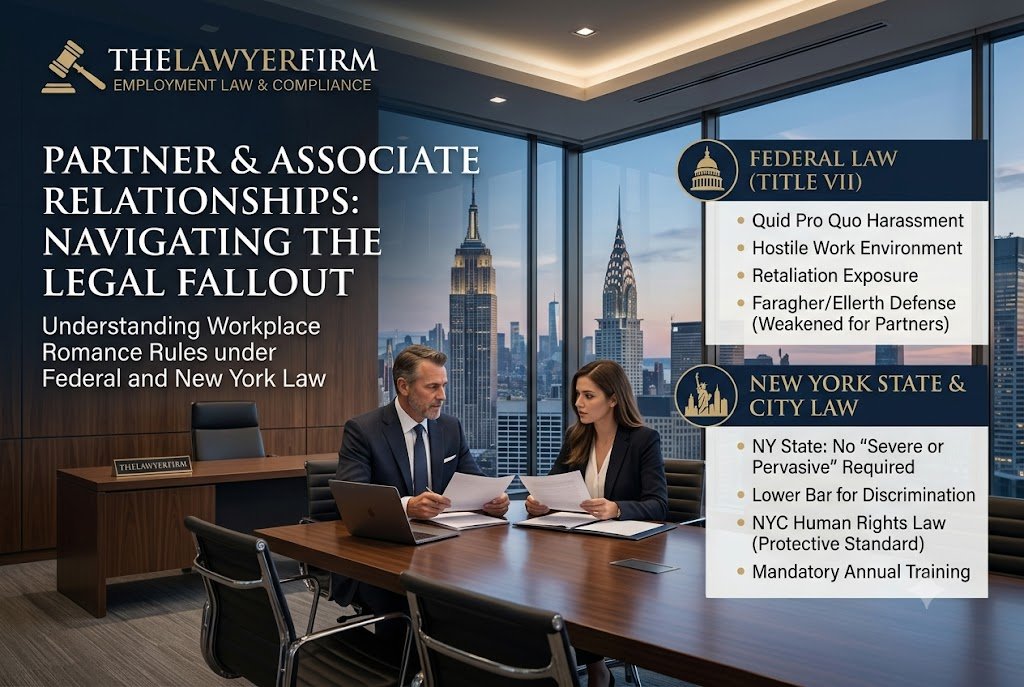
Workplace relationships between a supervising partner and a subordinate associate are common enough at large law firms that most have policies addressing them — and risky enough that those policies rarely prevent real legal exposure once a relationship ends badly. Consider a hypothetical, illustrative scenario: a senior partner at a large New York firm begins a relationship with a junior associate on his team. The relationship is initially consensual, but after it ends, the associate is reassigned to less desirable matters, passed over for a promotion, and eventually resigns. Whether or not the firm intended any retaliation, this fact pattern is exactly the kind that generates federal and New York state and city employment claims — and firms handling it badly can face liability under several overlapping legal theories.
Why ‘Consensual’ Doesn’t Mean ‘Risk-Free’
The law does not treat a relationship between a supervisor and a subordinate as automatically consensual in the legal sense, because the power imbalance itself can undermine true voluntariness. Courts examine whether the relationship was actually welcome, whether the associate felt able to decline or end it without professional consequences, and — critically — what happened to the associate’s career after the relationship ended. A relationship that began mutually can still generate significant legal exposure if the partner’s institutional power was used, even subtly, to influence the outcome.
Again, there is no allegation of wrong-doing by Nathanial Cullerton, but that does not reduce the level of risk he and the firm will face if Kelsey Borenzweig does file suit.
Federal Law: Title VII Exposure
| Theory | Statute / Case Law | What It Requires | Practical Note |
| Quid Pro Quo Harassment | Title VII, 42 U.S.C. § 2000e-2(a)(1) | Employment benefits conditioned on submission to a supervisor’s advances | Firm liability generally strict once established |
| Hostile Work Environment | Title VII; Meritor Savings Bank v. Vinson, 477 U.S. 57 (1986) | Unwelcome conduct severe or pervasive enough to alter working conditions | Employer can raise the Faragher/Ellerth defense |
| Retaliation | 42 U.S.C. § 2000e-3(a) | Adverse action taken because the employee complained or ended the relationship | Often the strongest claim once a relationship sours |
| Employer Affirmative Defense | Faragher v. City of Boca Raton; Burlington Industries v. Ellerth (1998) | Requires reasonable care to prevent/correct harassment and a failure by the employee to use it | Unavailable if the harasser is a firm partner with ultimate authority over the associate |
Critically, the Faragher/Ellerth defense — which normally lets an employer avoid liability if it had a strong anti-harassment policy and the employee failed to use it — is significantly weakened when the harasser is an equity partner with authority over firm-wide decisions like compensation and staffing, rather than a mid-level manager.
New York State and City Law: A Higher Bar for Employers
New York law is considerably more protective of employees than federal law in this area, and law firms operating in injury lawyer manhattan need to evaluate exposure under both state and city standards, not just Title VII.
| Protection | Statute | Key Feature | Effect on Firms |
| NY State Human Rights Law | Executive Law § 296 | No longer requires conduct be ‘severe or pervasive’ — any unwelcome conduct that rises above ‘petty slights’ is actionable | Broader than federal Title VII standard |
| NYC Human Rights Law | NYC Admin. Code § 8-107 | One of the most protective harassment standards in the country | Applies to any employer with 4+ employees in NYC |
| Mandatory Anti-Harassment Policy | NY Labor Law § 201-g | Requires written policy and annual training for all employees | Firm’s own policy often becomes evidence in litigation |
| Non-Disclosure Agreement Limits | CPLR § 5003-b; General Obligations Law § 5-336 | Restricts confidentiality provisions in harassment settlements unless the complainant’s preference controls | Limits a firm’s ability to quietly settle these matters |
What Typically Happens Next
In practice, these situations tend to unfold in one of a few predictable ways. The associate may raise an internal complaint through HR or the firm’s general counsel, triggering an internal investigation that itself must be handled carefully to avoid appearing retaliatory. The associate may resign and later file an EEOC charge or a complaint with the NYC Commission on Human Rights, which are typically required steps before a Title VII lawsuit but are not required under the NYC Human Rights Law. Alternatively, the firm and associate may negotiate a confidential separation agreement — though New York law now limits how broadly confidentiality provisions can be enforced in matters involving harassment or discrimination allegations.
Practical Guidance for Associates and Firms
- Associates should document any change in assignments, staffing, or opportunities that follows the end of the relationship
- Firms should route any internal complaint through counsel independent from the partner involved
- Neither party should sign a severance or settlement agreement without independent legal review
- Firms should audit whether the partner had unilateral authority over the associate’s staffing, review, or compensation
Why Experienced Employment Counsel Matters
These matters sit at the intersection of employment law, partnership governance, and reputational risk, and they rarely resolve cleanly without experienced counsel on both sides. An associate evaluating a potential claim should consult an experienced NY employment lawyer before signing any severance paperwork or making a public statement, since early missteps can undermine an otherwise strong claim. A firm facing this situation should likewise engage a manhattan employment attorney to conduct a proper internal investigation, assess exposure under both Title VII and New York’s more protective standards, and structure any resolution in a way that withstands scrutiny.
Whether the matter remains an internal HR issue or develops into an EEOC charge, a state human rights complaint, or litigation, a knowledgeable employment attorney new york professionals turn to in high-stakes workplace disputes is best positioned to protect a client’s interests — whether that client is the associate whose career was affected or the firm trying to manage the fallout responsibly.